Bringing motion capture in the wild to study natural courtship behavior
Quantifying natural, undisturbed behavior can be highly challenging. Here I present an experiment quantifying close to natural courtship behavior in Morpho butterflies, using a motion capture setup that I built directly in the wild.
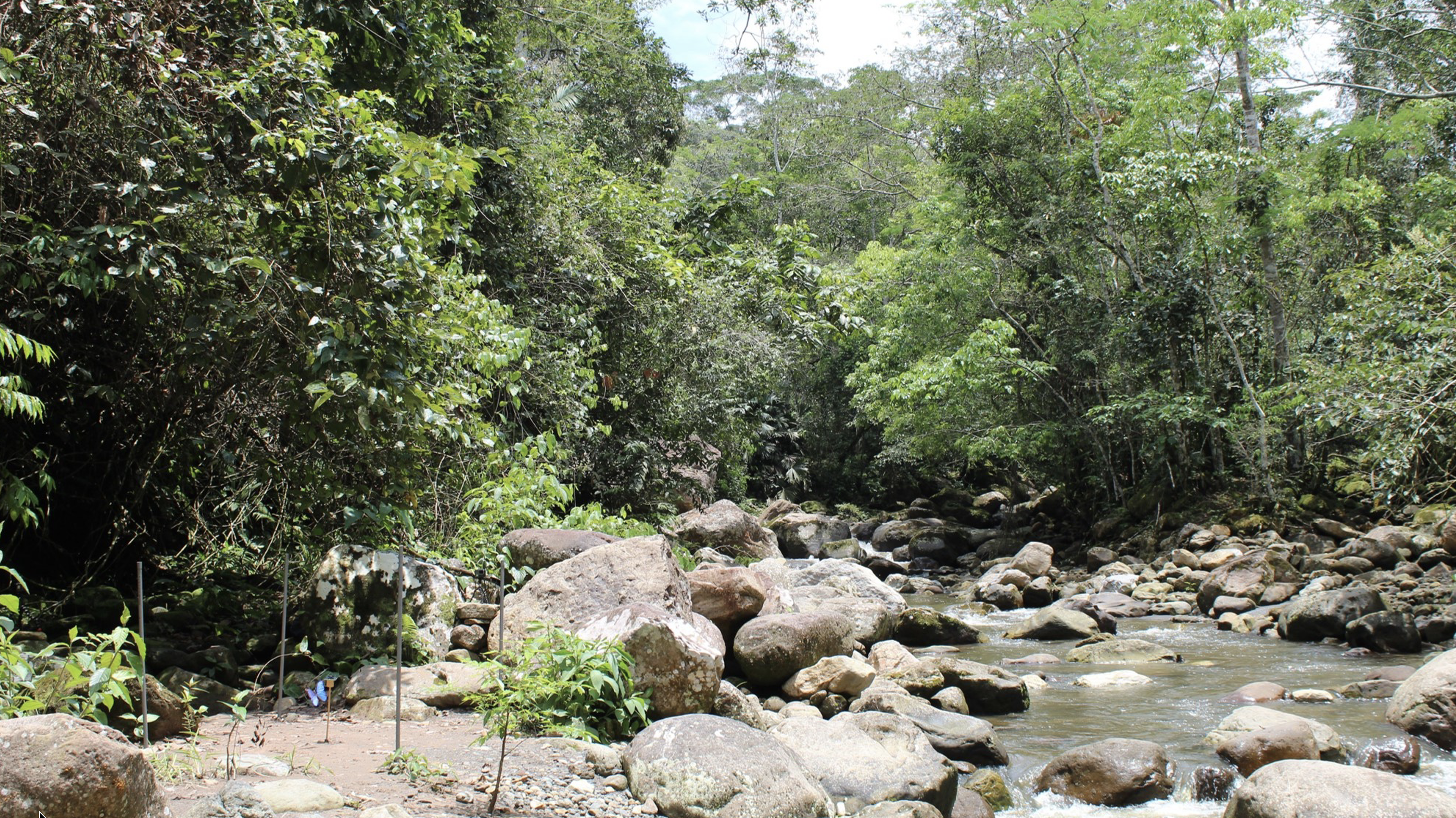
The experimental setup near the river bed
Positioning the experiment in the path of passing butterflies
Ecological and field knowledge about your study species is crucial if you want to film its behavior in natural settings. In my case, I had identified a small river in the Peruvian Amazon along which a large number of individuals from my target species were flying. From my field experience, I also knew exactly what time of day their peak activity occurred.
With this in mind, I designed a simple but efficient motion capture setup right on the bank of that river and intercepted passing individuals using a solar-powered dummy butterfly. This moving dummy allowed me to experimentally induce and manipulate intra- and interspecific courtship, as well as male-male competitive interactions, in a completely undisturbed environment.
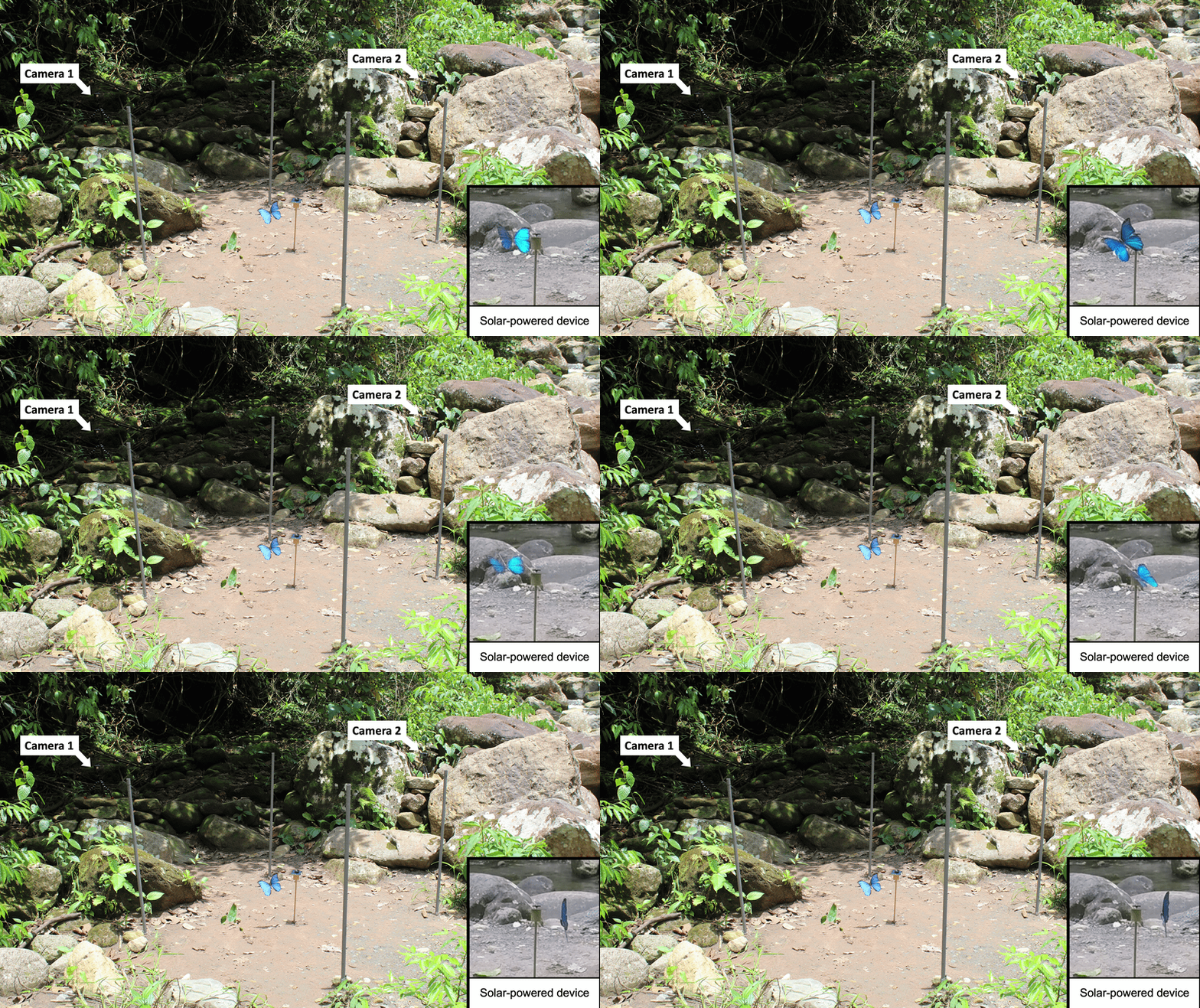
The solar-powered fluttering dummy attracting passing congeners
A simple, fully portable motion capture setup
The fluttering dummy was set up on a riverbank in the middle of a 1 m3 space marked out by four vertical sticks, delimiting a field arena.
To capture detailed 3D flight paths of butterflies entering the delimited space, two consumer-grade GoPro cameras were orthogonally positioned around the dummy. Before each filming session, the camera system was calibrated using a wand method, allowing precise calculation of spatial positions, speeds, and accelerations at each instant.
On the practical side, multiple camera batteries and custom sun covers were used to protect against intense sunlight and keep the cameras running in high temperatures for as long as possible.
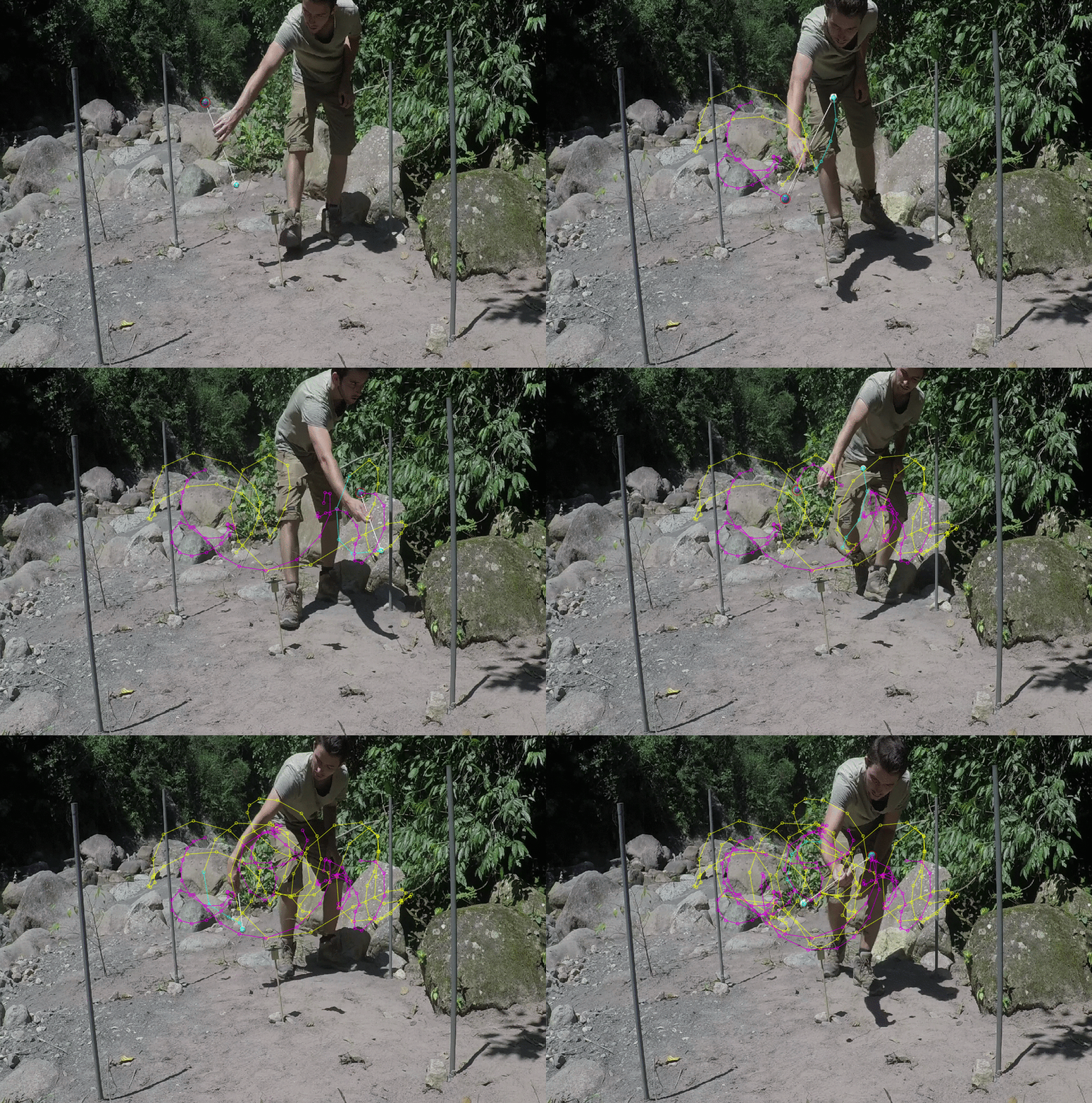
The motion capture setup was calibrated using the highly flexible wand method
The science behind the experiment
Morpho blue signal reduces individual predation by advertising their high escape ability, favoring resemblance between species living in the same locality. This led to the widespread wing pattern convergence of several blue-banded Morpho butterfly species with overlapping ranges of distribution (Llaurens et al., 2021). It was unknown whether the convergence in wing color pattern among co-occurring Morpho species lead to heterospecific rivalry or courtship
Morpho blue signal reduces individual predation by advertising their high escape ability, favoring resemblance between species living in the same locality. This led to the widespread wing pattern convergence of several blue-banded Morpho butterfly species with overlapping ranges of distribution (Llaurens et al., 2021). It was however unknown whether the convergence in wing color pattern among co-occurring Morpho species lead to heterospecific rivalry or courtship.
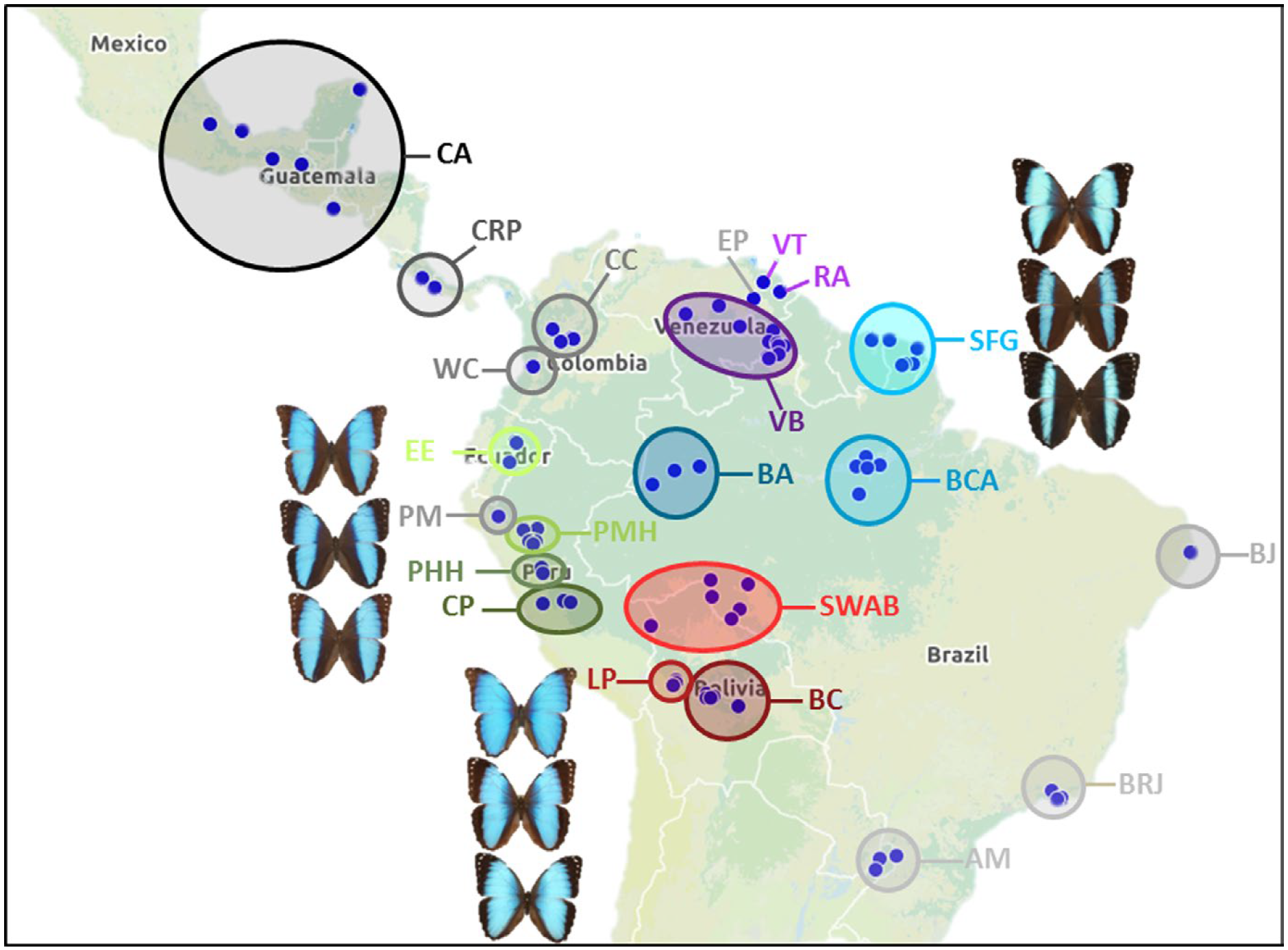
Wing pattern convergence among co-occurring Morpho butterfly species (Llaurens et al., 2021)
Using this original experiment, we showed that this morphological convergence induces interspecific behavioral interference, by triggering erroneous courtship and male-male competition. Genomic data nevertheless revealed a surprising strong genetic isolation between species despite these inter-specific interactions.
Later, a mark-recapture experiment revealed a remarkable temporal divergence in flight activity among species, probably facilitating their coexistence and explaining their isolation. Hence, the convergence in morphology and divergence in phenology likely favor species coexistence by partitioning niche in different dimensions.